
Inferno Callouts in CS2: Complete Map Guide
 radoslaw-davidovic
Inferno is one of the most beautiful and interesting maps in the game. However, to play effectively, just running and gunning isn’t enough. You also need to share quality information about enemies with your teammates, because communication in CS2 is a key skill for winning!
To give the right information, you need to know what specific places on the map are called. So, today, we will look at all the Inferno callouts so you can accurately coordinate your allies or, conversely, clearly understand where the enemy is when your teammates give you info!

So, let’s start exploring all the Inferno map callouts!
In article you will find:
Overview of Inferno (Map Background & Layout)
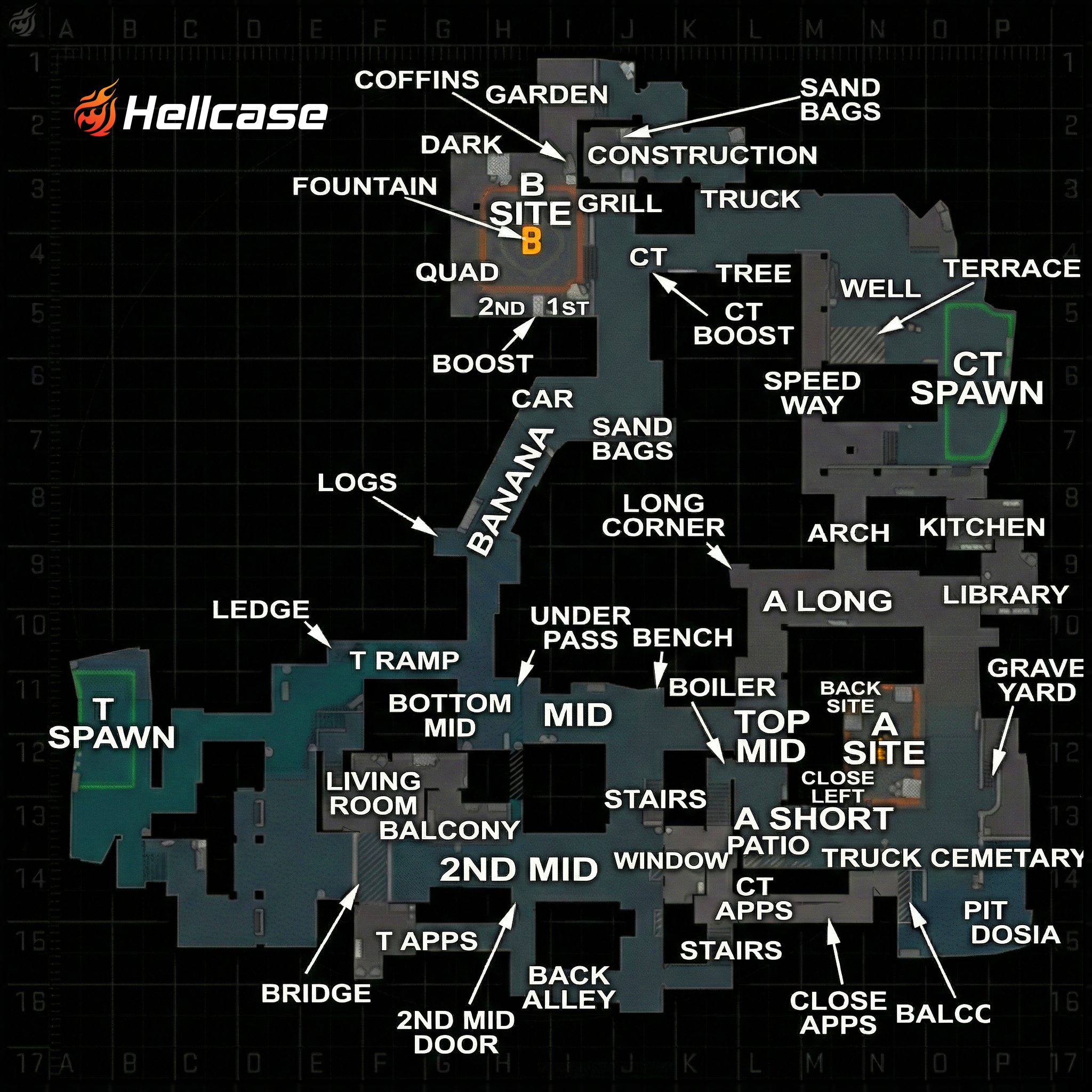
If you are a beginner at the game, it’s important to first get familiar with the map itself.
The map was created by Christopher Auty and appeared in Counter-Strike 1.1 in June 1999. Over the years, Valve has repeatedly reworked the map, changing the balance and visuals, but the basic structure has remained the same. Originally, the map was inspired by Californian architecture (a mission in San Juan Capistrano), but over time it transformed into a cozy European town.
- CS 1.6: The map was gloomy and technical with simple textures. It was set at night or late evening.
- CS:GO (Early): Moved the action to Italy and added a yellowish fog, which many players disliked due to poor visibility.
- CS:GO (2016 Update): Valve released an update making the map brighter and wider (they widened the Banana position and some other streets). More flowers appeared, making it one of the most beautiful maps in the game.
- CS2: A complete overhaul built on the Source 2 engine.
The map itself is quite simple and linear. It has three main directions: the path to B, the path to Mid (from which you can go to either A or B), and, of course, a separate entrance to A. Everything is fairly standard. However, the map’s unique feature is that it is quite narrow, and you often encounter opponents at close range, making aim skills very important here!
As for interesting facts: Inferno is the map with the most chickens running around. Also, at T-Spawn, there are bells you can shoot to play a melody (a favorite activity for Terrorists during a pause). There is also a radio playing classical Italian music, but it goes silent as soon as the first firefight begins!
How to Use Callouts — Best Practices
Using callouts in the game is very simple. To show this with an example, here is a small situation that might happen in your game.
Imagine you are with the Terrorists trying to push the center of the map (Mid), but somehow your teammate gets killed and gives info that the opponent is at Banana. So, when peeking out from Pit to Mid, you should look left, not straight, because that’s where the enemy was, according to your teammate.
Or, for example, another situation: you have already planted the bomb on A Site and decided to hide on the Balcony near the position. But while you were watching one side, your teammate was killed. The info is that the enemy is somewhere in the Library. In this case, you can easily understand where to look and won’t expose yourself too much, as you have the perfect position to meet the opponent.
It is exactly these situations and precise enemy locations that ensure victory in games. It’s easier to play knowing where the opponent is, isn’t it? The same goes for your allies – it will be easier for them if you give timely and accurate information. This will increase your chances of winning and definitely boost your Premier rating!
And if you want to know how to rank up faster, check out our article!
Inferno Callouts by Region
To make it easier to understand all the CS2 Inferno callouts, it’s worth dividing them into several regions. This way, it will be easier for us to explain and for you to remember the positions. So, let’s move to the first part of the map, specifically A Site.
Before we move on, make sure to check out our guide to the CS2 ranking system.
Inferno A Site Callouts
Looking at A Site from above, you can immediately see many positions. Some might be familiar to many because they are incredibly easy and associative, for example, Balcony or Pit. However, when we talk about Inferno callouts CS2, you need to understand that there are significantly more of them, and practically every corner has its own name. So, let’s look at the image and examine what is located where.
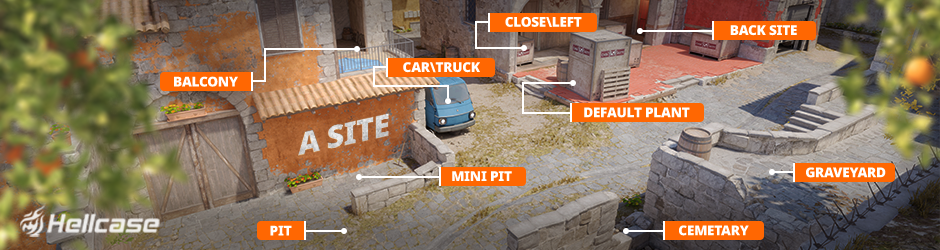
As you can see, A-Site is a complex structure with plenty of angles. Let’s break down the main Inferno map callouts for this zone:
- Apartments (Apps): Narrow corridors with carpets through which Terrorists often exit onto the site.
- Balcony: The exit from Apartments to the fresh air. This is a dangerous position because you are visible from everywhere (from Pit and Site), so you need to jump out carefully.
- Pit: The lowest point on A-Site and arguably the strongest position for defense (CT). From here, you can control the exit from Apartments and Short, hiding behind the wall. Just watch out for grenades, as Molotov cocktails land here often.
- Mini Pit: A small corner under the balcony next to Pit. Often used to bait or to hide when Pit is being flooded with grenades.
- Graveyard & Cemetery: This is a funny situation because the position “Cemetery” usually exists only in photos, but in reality, players call both areas “Graveyard.” This includes the stone platform behind Pit and the raised platform opposite the Plant.
- Site / Default: The central zone with boxes where the bomb is usually planted. The boxes provide decent cover to circle around during a clutch.
- Short (Truck): The passage to the site from the Mid side (on the right if looking from the attack). You might also hear the word “Car,” so I think you can easily orient yourself on where this position is.
- Back Site: The furthest point of the plant (behind the boxes, closer to Library). This is a “safe” position: players retreat here when things get hot to save their weapon, stay alive longer, or wait for backup from B.
- Close: Also called Boost, this is the position right up against the site entrances—a tricky corner to the left of the attack. It is a favorite spot for eco-rounds to catch an enemy off guard.
At first glance, it seems quite simple, but believe me, in tense moments people forget everything they remembered. So, if such a situation happens to you and you forget these positions, be sure to visit us to refresh your memory. But we are moving on and will next look at Inferno callouts on B Site.
Inferno B Site Callouts
On the B Site, there are slightly fewer positions to hide in because the area is much narrower than the A Site. However, there are still many tricky corners where Counter-Terrorists can hide, so you need to understand exactly where to look if a teammate screams “DARK” at you during a B Site attack!
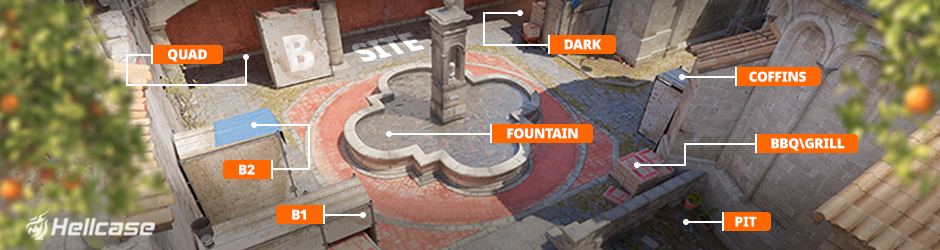
As seen in the photo, the position is indeed quite small, but there are interesting places where an enemy can hide. Let’s look closer:
- Coffins: The position near the passage to CT. The name comes from a stack of coffins that used to be there. Now they are just boxes/bags, but the name remains. It’s convenient to watch Banana from here.
- Dark: A dark corner in the very depth of the site. An ideal place for a deep defense or a good moment to kill someone in the back when enemies enter the plant.
- Grill: The area in the center of the site where there used to be a pool (in 1.6) or a grill (in CS:GO). Players still use the old names. The bomb is planted here most often.
- First & Second Oranges: Two covers on the site itself. “First” is closer to the entrance from Banana, “Second” is further back.
- Pit (Water): Attention, do not confuse this with Pit on A. Here, it is the corner near the fountain and the passage to CT Spawn. Professional players very often take this position for defense.
- Fountain: This is the central object on the plant. In CS2, the water looks very realistic, so most players just call this place “Fountain.” The bomb is often planted here so it can be seen from different angles (e.g., from CT or Banana).
- Quad: This name migrated from other maps. On Inferno, “Quad” usually designates the zone with boxes and pillars on the site itself. This is a place where a defender can rotate around the cover, controlling both Banana and the exit from Church.
Well, we’ve covered the main positions. Now let’s move on to Mid!
Inferno Mid
It is incredibly important during an attack, before you have reached one of the bomb sites, to communicate and call out positions where enemies are. Counter-Terrorists don’t sit on the bomb site waiting for you to kill them. They spread out across the map to fight back. That is why Mid is one of the most vital parts of Inferno.
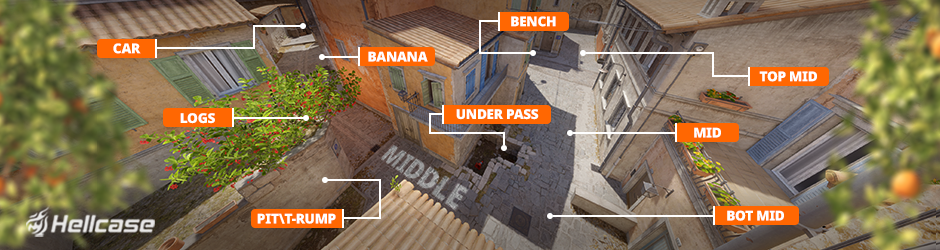
As you can see, controlling the center of the map and “Banana” is the key to victory on Inferno. Here are the main Inferno callouts you need to know coming out of the Terrorist base:
- T-Ramp / Pit: This is the exit from T-Spawn towards Mid. It is from here that attack snipers often try to pick someone off at Mid.
- Bottom Mid: The lower part of Mid, immediately after the ramp. This is a safe zone for Terrorists to gather before an attack if Top Mid is smoked off.
- Mid: The main straight street leading up to A-Site. The most dangerous zone for long-range firefights.
- Bench: A small alcove with a bench on the left side of Mid (if looking from the attack). This is a popular spot when attacking Top Mid.
- Underpass: The underground passage in Mid. From here, you can safely cross to Second Mid and flank enemies or check Apartments.
- Top Mid: The upper part of Mid, closer to Arch and Boiler. If Terrorists take “Top Mid,” they control almost the entire map.
- Banana: The curved passage leading to B-Site. The most important strategic zone on the map. It is almost always under Terrorist control.
- Logs: A position in the lower part of Banana where a pile of wood lies. Terrorists or aggressively pushing CTs often hide behind them.
- Car: The upper part of Banana, before the entrance to the plant itself. In CS2, there is no car there (now it’s barrels and plywood), but the name remains. This is a standard position for a defense sniper.
Actually, there is an incredible number of different Inferno callouts CS2 that you should know, especially when attacking A Site through Second Mid. What is that? Let’s figure it out!
Other Important Inferno Callouts
Besides the main spots on the sites, Inferno has a complex system of rooms and transitions. Knowing these names will help you orient yourself perfectly during rotations, so let’s look at all the other important positions on the map.
Apartments & Second Mid Area:
- Second Mid (Alt Mid): The alternative center – a long street to the right of the main Mid. It is a safer path for an attack to approach Apartments, but be careful. Sometimes a CT takes the “Window” position, which controls this street.
- T Apparts: The entrance to apartments from the Terrorist side (across the bridge). CTs often hold aggressive pushes here.
- Back Alley: A narrow street/corridor leading from T-Spawn to Second Mid and the Apps entrance.
- Bridge: The wooden-stone bridge inside the apartment building connecting the entrance zone with the living rooms. It’s the only one on the map, so you definitely won’t get lost.
- Kitchen: The first room in the apartments after crossing the bridge if you are coming from T-Spawn.
- Living Room: The large room in the apartments before the exit to the balcony. Usually, there is a sofa or TV here.
- Window: The window from which you can look at Second Mid. A popular place for AWP shots or throwing grenades – exactly what we mentioned when discussing Second Mid.
- Boiler: The door (and stairs) at the end of the apartments leading out to Top Mid. The name is legendary and comes from an old boiler that stood there in previous versions of the game.
- CT Apparts: The part of the apartment hallway closest to the balcony and A-Site. Defenders with shotguns often hide here.
A Site Connectors & Rotations:
- A Short (Truck): The short path to A-Site from Mid. Leads past the roof (Patio) straight to the plant.
- A Long (Arch): The long path to A-Site through the Arch. This is a zone for long-range duels.
- Library: The room connecting Arch and A-Site. In CS2, it is a wine cellar, but the name “Library” is used by all players.
- Speedway (Speed Alley): The path running from Arch towards CT Spawn. This is the fastest route to rotate from A to B (or vice versa).
- Well: A decorative well located in the CT Spawn / Terrace zone. Often used as a landmark when players are saving weapons at the end of a round.
B Site Specifics:
- Ruins: This name is often used as a synonym for “Church” (Construction) on B-Site, because in CS2, this building looks like a semi-ruined church.
- Garden: The zone with flower beds on the B-Site itself. Roughly speaking, this is what they call the entire back part of the plant where there is grass and flowers, and the passage into Church.
Callout Usage in Game Scenarios
Knowing the names of spots is only half the battle. The main thing is being able to quickly combine them into sentences to give your teammate a full picture of the fight. Let’s look at one example where CS2 Inferno callouts save the round.
You are entering Banana. Your entry-fragger is waiting for grenades. You throw a grenade, but something goes wrong, and the enemy sniper kills your ally. However, your ally shouted the position name, something like “Sniper at Car, one pushing Sandbags.” This immediately tells you what to do: specifically, throw a “Molly” behind Car and a flashbang to peek the player standing behind the bags.
And when you have already entered the site, info like “Bomb planted for Coffins, watching CT” allows your friend at Ruins to know that his back is covered, and he can focus on Church.
Common Mistakes, Ambiguous Callouts & Conflicts
With the transition to CS2, Inferno received a significant visual upgrade, and this created a bit of confusion. Here are the main points where beginners often make mistakes:
- Library vs Wine Cellar: In CS2, the building behind A-Site looks like a wine cellar, not a library. But if you say “Cellar,” you might not be understood. Use the old name, Library.
- Construction vs Church: Same story on B. Previously it was a construction, now it’s a beautiful church. Here, players use both names, and sometimes even Ruins. All three options are acceptable, but Church is becoming the standard for CS2 Inferno callouts.
- Graveyard vs Cemetery: As we already found out, the official name of the platform on A is Graveyard. Although “Cemetery” means the same thing, it is better to use the generally accepted term to avoid communication delays.
To Sum Up!
Inferno is a map where communication matters more than many players realize—some even say more than raw aim. That said, solid mechanics are still essential, as the streets are narrow and most fights happen at close range. So don’t just train your brain by memorizing callouts—make sure your shooting skills are sharp as well.
Don’t try to learn everything in one evening. Play a few matches while focusing on one area at a time, and these callouts will quickly become second nature. And if you’ve already mastered Inferno and want a new challenge, be sure to check out our Anubis callouts guide to dominate the sands of Egypt.
FAQ
The biggest changes concern visuals: “Construction” became “Church,” and “Library” now looks like a “Wine Cellar.” Also, “Pool” on B-Site became a proper fountain, but players often use old names out of habit.
In most cases – yes, English names are universal. However, different regions may have local slang names (for example, “Mexico” for Underpass or “Diggity” for Short in some communities).
Inferno is inspired by European architecture, particularly Italy. In the CS2 version, developers added more details reminiscent of Italian towns and wine regions. The original 1.1 version, however, was inspired by a mission in California, and no specific real-world city has ever been officially confirmed.
Historically, Inferno has been considered a map oriented towards defense (CT-sided) due to narrow passages that are easy to control with grenades.

Radosław Davidović is Hellcase’s customer success manager. He enjoys blogging to share his knowledge and experience with customers.