
Nuke Callouts in CS2: Complete Map Positions & Strategy Guide
 milica-dobrev
Nuke is, without a doubt, one of the most challenging maps to play for both Terrorists and Counter-Terrorists. While the map feels spacious, its bombsites are very enclosed, making fast and accurate communication essential.
To help you succeed and figure out all the locations on the map, we’ve created a detailed guide on Nuke callouts. We’ll go over not just every spot name, but also some key tips and gameplay strategies you can actually use.

Let’s jump in!
In article you will find:
Overview of Nuke
As we’ve mentioned, Nuke is one of the most tactically challenging maps, but it’s also an iconic map carried over from the legacy of CS:GO. It has been available since the launch of CS2, maintaining its status in the competitive map pool. While many players are aware of this, here’s a fact that might be new to some: the original version of the map was created by Jo Bieg, with later iterations developed by Valve and Hidden Path Entertainment.
Perhaps everyone knows that the main feature of this map is its two-level layout. The map has two bombsites (A and B) stacked on top of each other. The A site is located on the upper level, while the B site is located on the lower level. This unique layout creates complex gameplay where sounds and understanding player positions across different levels are the key to victory.
The tight, narrow spaces further complicate this, meaning your skills need to be sharp to succeed on this map. Otherwise, you’ll find yourself losing often or simply wondering how your opponents are playing so effectively.
However, you can make that task easier for yourself right now by learning the key positions on Nuke.
How to Use Callouts — Best Practices
If you’re unfamiliar with the term “callouts,” don’t worry, we’ll break it down for you. It’s quite simple. Callouts are specific names for positions, locations, or spots on the map where an enemy could be.
When communicating an opponent’s location, you need to use a specific name that instantly informs your teammates of their exact position. If you know precisely where an enemy is hiding, you can tell a teammate, and they’ll be more cautious around that area. They could also use a grenade to flush them out or finish them off, which could be the key to winning a crucial round!
To make navigation easier, CS2 players have created names for every corner and spot on the map. Typically, these names are based on what you actually see in the location. For example, a large box might be called Box, and a stack of three boxes is called Triple.
And suppose you enjoy playing on Anubis as well as Nuke. In that case, we recommend checking out our article about Anubis callouts, where you’ll find the most useful information about the positions on that map.
Nuke Callouts by Region
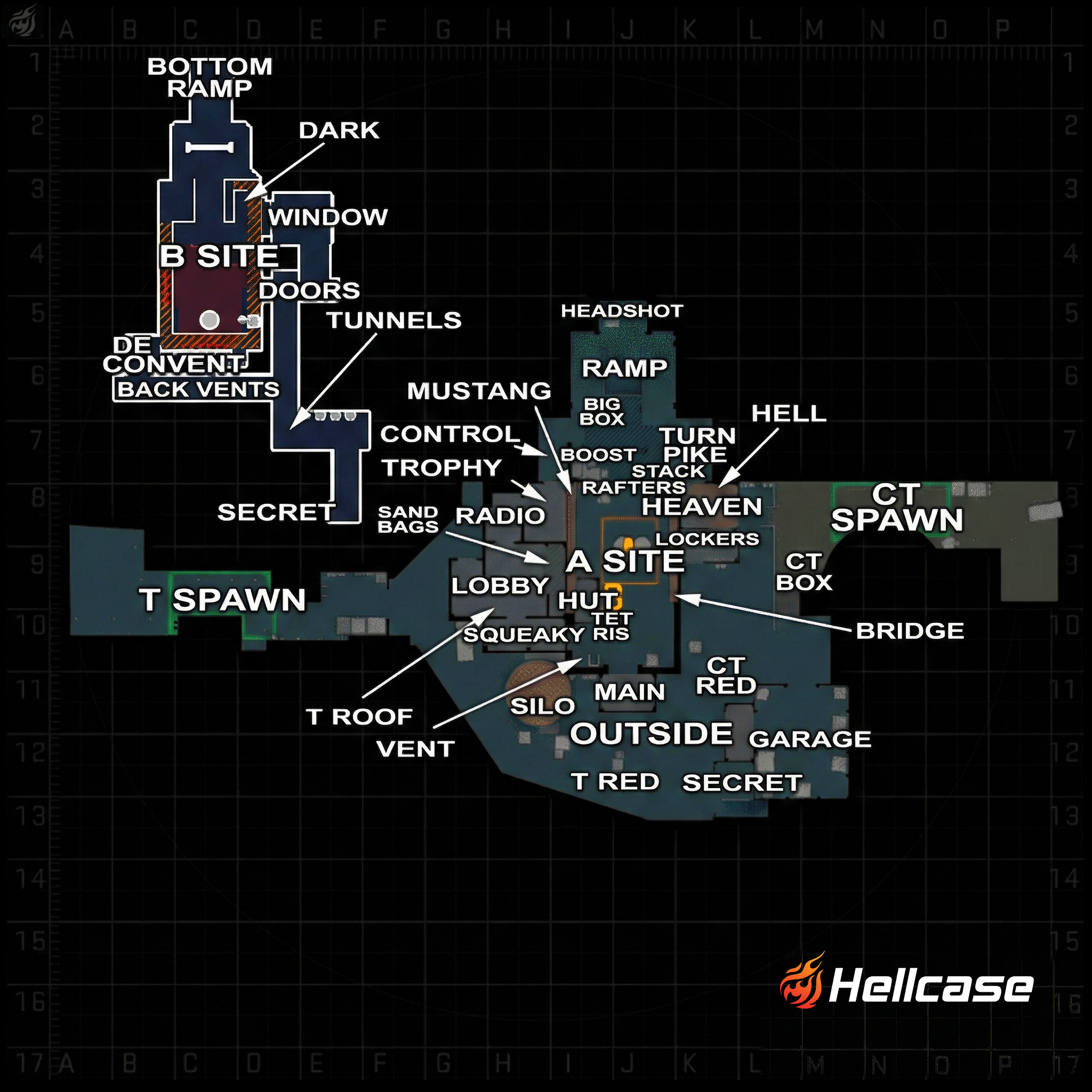
Looking at this map, you’ll see a ton of Nuke map callouts that might not mean anything to you. That’s why, instead of just listing positions like most sites do, we are going to take a detailed look at the key locations on the map, showing you what each spot looks like and what it’s called. We’ll start with the upper level, focusing on the A Site.
Upper Level & A Site Callouts
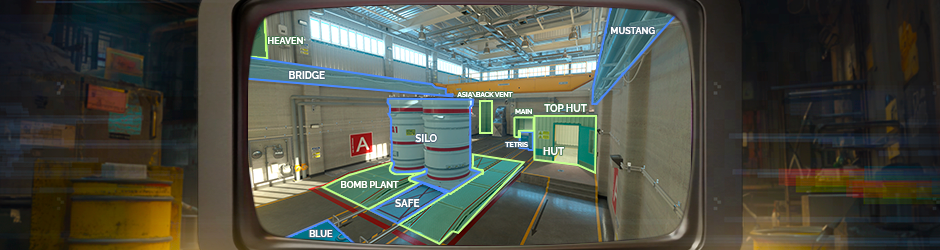
Alright, let’s start exploring the Nuke callouts with the place where Counter-Terrorists and Terrorists clash most often: the A Site. Looking at the image, the camera is positioned in the very corner, giving you a view of almost the entire A site, except for one position called Vent. It’s located right behind this small building, and it serves as a crucial rotation path, allowing players to move quickly between the upper and lower levels.
Speaking of that small building, it also has its own name and is simply called Hut. Sometimes, Counter-Terrorists will jump on top of its roof, and in that case, a teammate might call out that an enemy is “on top of Hut.” Next to this position, you’ll see two large silos; this is the primary area for planting the bomb. You can plant anywhere around these silos that works for you, but players most often plant in the more protected spot known as the Default position.
To the left of the silos, there’s a yellow platform against the wall. This spot is called Drop because players in Heaven (the spot in the upper-left corner) often drop down to it, which is where the name comes from. To the right of the bombsite, there is a blue container, and it’s simply called Blue.
If you look straight ahead from the bombsite, you’ll see a closed ventilation duct known as Asia, Fake Vent, or sometimes Back Vent. You might sometimes find a Counter-Terrorist there, watching the entrance to the A site from Main and the entrance through Squeaky (Doors).
However, Counter-Terrorists on A Site most often prefer to play from above, holding positions on the Rafters like Bridge, Mustang, and Heaven. So, be cautious and always check the high ground, as the A site anchor could be waiting for you up there.
And if you’re looking to rank up easily in CS, we have an interesting article that will help you do it more quickly and smoothly.
Lower Level & B Site Callouts
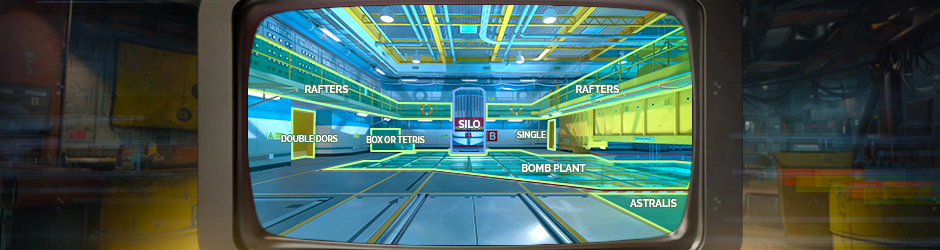
Now let’s move on to the site that is harder to play, though it has slightly fewer CS2 Nuke callouts to memorize. Note that around the B bombsite, there are also metal beams called Rafters. This spot is just as dangerous as the top-level positions on the A site, as it adds another risky area you need to worry about.
The large silo in the middle of the site is the primary plant spot. You can plant the bomb anywhere around it, depending on your team’s position, but players most commonly plant behind the silo. This is one of the most protected spots, which is fittingly called the Safe plant.
The boxes on the left are often referred to as the Boxes or the Ninja spot. As seen in the photo, there are two doors: the one on the right is simply called Single Door, while the one on the left is known as Double Doors.
Outside, Yard, Mid & Rotation Callouts
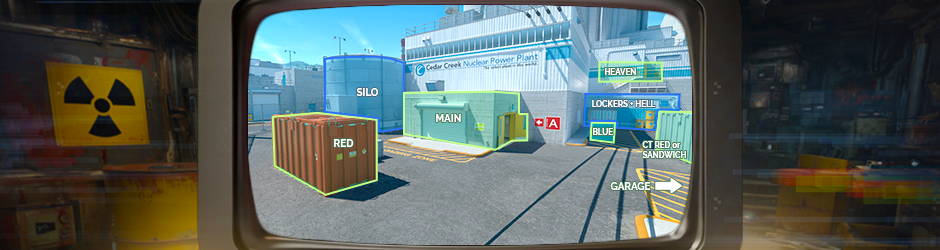
Most fights on Nuke happen outside the main building – the area known as Outside. It’s full of angles and cover spots, so let’s go over the key Nuke callouts CS2 that’ll help you give cleaner info to your team.
The first thing you’ll spot is the large tank, called Silo. Terrorists can easily climb on top of it, so keep an eye up there if you’re on the CT side – it’s a popular perch for snipers.
If the Ts don’t rush into the building, they’ll usually try to take control of Outside. From here, they can push toward A Site through Main or sneak down to B Site using Secret. But as you can see, Outside is wide open, which makes it tough for Ts to move without dropping some smokes.
You’ll often see them fighting for control around Red Box. To counter that, CTs usually hold from Garage. And if you’re an AWP enjoyer, Heaven is an excellent spot – it lets you cover both A Site and Outside, which can completely shut down the Terrorists’ attack.
Callout Usage in Game Scenarios
To see how callouts work in real matches, let’s go over a couple of quick examples.
Say you’re on the T side and want to push Outside. Crossing that area without taking damage is tough, but if you know the Nuke callouts, you can ask a teammate to throw a smoke grenade to a specific spot. For this, you could say, “smoke between Red and Secret.” Once the smoke lands, you’ve got a safe path down to B Site – clean and simple.
Now, picture this: you’ve already planted on A Site and have full control. But there’s always a chance someone flanks from above. Instead of explaining the whole thing, just call one word – “Heaven.” Instantly, your team knows where to aim. That’s the power of good CS2 Nuke callouts.
Common Mistakes, Ambiguous Callouts & Conflicts
To climb the ranks, you need more than just good aim. You also have to effectively use the information your teammates provide, utilize your utility, and understand the basic callouts for every map you play on.
Sometimes, players make the mistake of using different names for the same position. However, this is often just a matter of habit. It’s impossible to correct every player. Some are used to one callout, while others use a different term. Of course, it’s ideal when everyone uses the same names, but this is a game with a diverse community, and people might call positions differently. That’s precisely why we’ve listed positions along with the alternative names you might hear in-game.
If you’re ever in a situation where you don’t understand a teammate’s callout, just ask them to repeat it or clarify what they mean. In such cases, the person will usually realize they should use a more common alternative for that spot.
Another frequent mistake people make is not saying anything at all. Yes, silence is also a mistake. You’re playing a fast-paced shooter where decisions must be made quickly. If your teammates know an opponent is pushing a site, they can use their grenades or rotate to gather their forces where needed. Don’t ignore the in-game chat. Help your team with information. This will not only help you win more often but also raise your rank!
And if you’re interested in learning all about ranks and how the CS2 ranking system works, we recommend checking out this article.
To Sum Up
Memorizing all the Nuke callouts CS2 at once can be tough. However, with our guide, you can speed up the learning process, as we’ve included images that visually pinpoint the positions. This should help many players get up to speed quickly.
If you enjoy our articles and want more useful content about the world of CS2, including its updates, skins, and much more, stick around and keep reading our blog!
FAQ
Actually, almost all callouts remain the same as they were. Even if a few have changed, you can still use the names you’re used to, as many people have been playing for years and will know what you’re talking about!
For Nuke, there have been no changes. All the positions that were previously referred to as “Ramp,” “Secret,” “Silo,” and “Heaven” remain unchanged, retaining their original names from CS:GO.
Of course, but it will likely just confuse your teammates, which could lead to a crucial round being lost. However, if you don’t know the name of a position but need to give info quickly, it’s better to just describe where the opponent was in your own words.

Milica Dobrev is a writer/editor at Hellcase. Her favorite computer games are CS2 and Rust. She likes to share her experience and knowledge with CS2, Rust and Hellcase lovers.