
Ancient Callouts in CS2: Complete Map Positions Guide
 milica-dobrev
Pretty much every CS2 player has dropped into Ancient, a unique map covered in designs that make it feel like you’ve stumbled upon recent Aztec or tribal ruins. But it’s more than just looks. The map is challenging because of its mix of narrow passages and wide-open spaces, which can be a real headache for Terrorists on the attack!
Today, we’re going to break down Ancient in detail, covering the locations and names of the most popular Ancient callouts so you can give clear info to your teammates. We’ll also tell you the most common mistakes players make and how to avoid them.

In article you will find:
Overview of Ancient (Map Background & Layout)
Ancient is a fantastic map that many players love for its unique look, filled with stone structures, overgrown rocks, interesting patterns, and, of course, jungle. All this combines into a captivating and incredibly pleasant atmosphere where you feel like an explorer discovering the ruins of an ancient city.
Some compare Ancient to another map that once existed in CS, de_aztec, which was set at the foot of a Mayan pyramid and filled with a similar atmosphere and designs. However, these maps are different and have a completely different layout. And that’s exactly what we’re going to talk about now.
How to Use Callouts — Best Practices
For those unfamiliar with the term, callouts are the same as positions, points, or spots. When you’re giving info about an opponent, you need to use a specific name that instantly tells your teammate the enemy’s exact location.
If you know exactly where an opponent is, you can relay that information to a teammate so they can be cautious of that spot, or maybe use a grenade to flush the enemy out or finish them off. The scenarios can vary, but for any of them to happen, you need to understand what to tell your teammate.
To make navigating easier, players have given names to almost every corner and spot on the map, which are usually based on what we see. For example, a large box on the map might be called box, or if there are three of them, players might say triple or triple box. Most of the names are straightforward, but that’s not always the case.
To help you avoid any awkward situations while playing on Ancient, we’re going to take a detailed look at all the Ancient callouts below. And if you’re also interested in the map Anubis, since it has a similar bright design and historical background, we recommend checking out our article on Anubis Callouts.
Ancient Callouts by Region
As we mentioned, many CS2 Ancient callouts are easy to remember because they look exactly like their names. However, some are less intuitive and take some getting used to, as the connection isn’t immediately obvious.
Below is a detailed image of the map with all the positions on Ancient. Here you can see Ancient map callouts that players most frequently use. While they can sometimes differ, for the most part, these are the names that anyone who plays Ancient will understand.
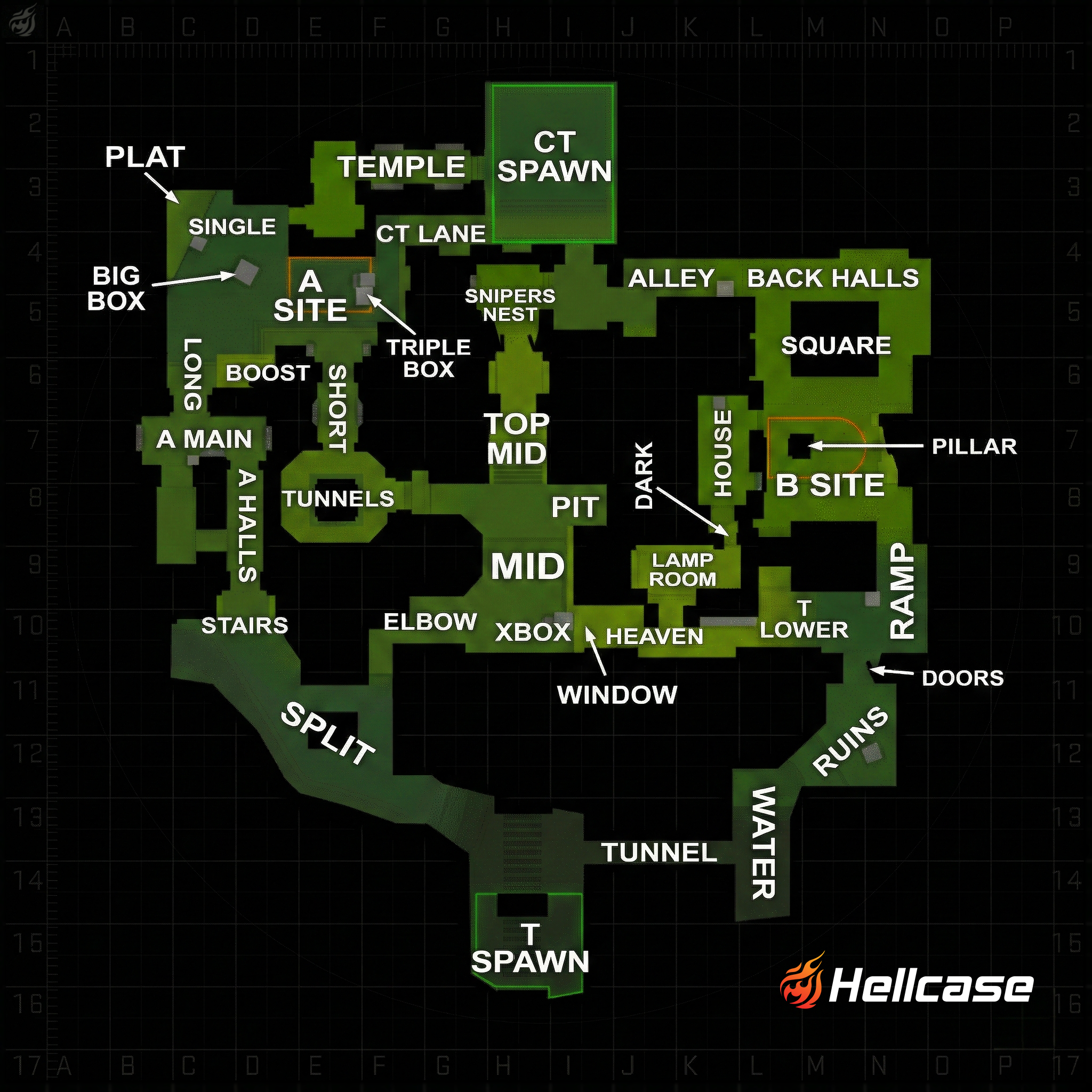
To avoid confusion with all these callouts, let’s break them down one by one, starting with the Ancient callouts CS2 on the A site.
Callouts on A Site & Surrounding Paths
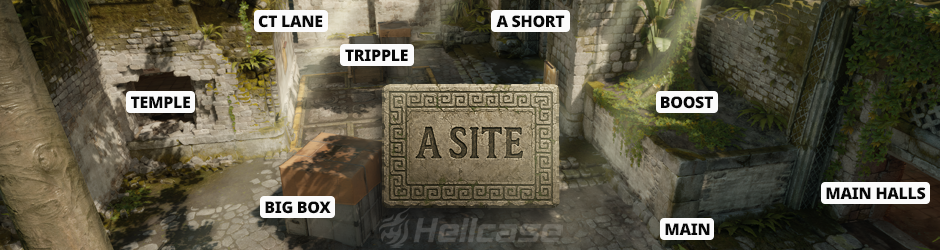
Looking at the picture, imagine you’re standing on what’s known as Plat. In front of you are two boxes. The first one is called Single – a spot you’re probably familiar with, as it’s a common hiding place for a defender trying to stop your push from Main. Behind that is the next box, known as Big Box, and just past them is the default plant spot on the site itself – Bomb plant.
Near the bombsite, things get more interesting. You’ll see a stack of three boxes, simply called Triple or Triple Box. To the right of these boxes is a circular passage called Donut – its shape makes the name easy to remember, so you won’t get confused when a teammate calls it out. To the left of the bombsite is another path named Temple. This is one of the main routes for Counter-Terrorists rotating to the site, so be cautious, as you’ll often find them waiting for you there.
Finally, let’s talk about the spot you’ll be pushing from. We’ve already mentioned that A Main is a primary path for Terrorists. However, it’s important to note a tricky spot to the right of the exit, where players can climb up and wait when you least expect it. This position is called the Boost because you can only get up there with help from a teammate.
Callouts on B Site & B Approaches
As you probably guessed from the previous section, just looking at the map isn’t enough to understand all the positions. Seeing them in context makes things much clearer. So let’s take a look at the B site and go over the main CS2 Ancient callouts around it.
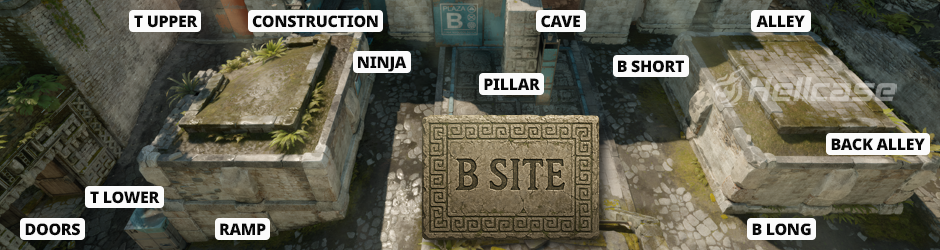
In the image, you can see that Terrorists start their push from Doors. Counter-Terrorists often throw Molotovs there to chip away some early damage. From that point, there are two main routes. The first is the direct path to the bombsite through Ramp – some players also call it Pit.
The second option is through T Lower, which gives Counter-Terrorists more flexibility since they can move toward Mid or take the path to Cave (sometimes called House, though that name isn’t as common).
If you’re playing on the CT side, you’ll usually encounter enemies coming from Ninja or from B Long / B Short. Just remember to use your grenades wisely to slow their push toward the plant!
Mid & Connector Callouts
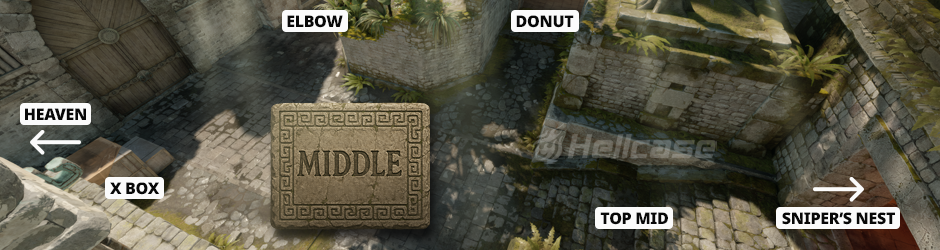
Another place you’ll often run into opponents is mid. It has its own set of Ancient callouts, so let’s take a closer look at them.
As you can see, the narrow corridor called Elbow is one of the lanes Ts can come out of – it’s tight and cramped, which is why CTs often like to spam it with grenades. So be careful when playing there.
Heaven is a position Ts can easily reach if they were pushing B plant but decided to rotate through mid via the aforementioned T Lower. So if you don’t want to play Elbow because it’s dangerous, but still want control of mid, Heaven is a solid alternative.
Counter-Terrorists can meet an attack from three main positions. The first and safest is the Sniper’s Nest, also called Red Room. The second position is already familiar to you, Donut, which we mentioned when reviewing A plant.
And the third, the most dangerous but also the most unexpected, is PIT. To get into PIT, a CT has to sprint straight for it and try to arrive before the Ts show up on mid. If they make it in time, they can catch the Ts by surprise. However, we don’t recommend using PIT often, because a single Molotov can force you out into the center of mid, where you’re easy pickings.
Common Mistakes, Ambiguous Callouts & Conflicts
We’ve gone over most of the callouts CS2 you’ll be using in your Ancient matches, looked at possible scenarios, and analyzed who can attack from where.
But even with all that knowledge, players still make plenty of mistakes on this map.
So, we’ve put together a few tips to help you avoid the most common and critical mistakes when playing Ancient.
Don’t rush. This might be the most important piece of advice not only for Ancient but for most maps in CS2. You have plenty of room to maneuver here, so if you’re playing as a T, you can easily switch up your plan mid-round. And if you’re on the CT side, don’t rush either – focus on staying alive and giving your team as much useful info as possible.
The second big mistake players often make is ignoring utility.
Sometimes it’s better to buy a cheaper weapon but use your grenades to block off an area, rather than buying an expensive gun and getting picked off by an AWP.
The third mistake is staying silent. If you know an enemy’s position, call it out! Don’t keep quiet – communicate with your team. Coordination is what truly separates good CS2 players from great ones.
And if you want to learn not just about Ancient callouts but also how to rank up faster in CS2, this next guide is definitely for you!
To Sum Up
Ancient is a stunning map with unique architecture and beautiful scenery. There are strange stone carvings, thick trees, and vines that hang down, which make it different from other maps. But it’s very important to know the callouts on Ancient. We hope you learned something new today. With this information, you will be able to win more games and improve your overall game strategy.
If you want to learn more about how the CS2 ranking system works, be sure to check out our blog and this article.
FAQ
If you played CS:GO and are just now getting back into the game, don’t worry. Players still use the same callouts on the map as they did before. Go ahead and give info the way you’re used to – everyone will understand you.
No, not all players use the exact same names. You’ll often hear different callouts, but they usually describe the spot they’re talking about in a logical way.
Temple is definitely a position on the A site. There is a similar-looking spot near Mid, but players usually just call that Connector.

Milica Dobrev is a writer/editor at Hellcase. Her favorite computer games are CS2 and Rust. She likes to share her experience and knowledge with CS2, Rust and Hellcase lovers.