CS2 Vertigo Callouts: Complete Map Guide
 radoslaw-davidovic
Understanding the callouts of any CS2 map is a crucial key to victory. Especially when it applies to two floors, along with vertical angles to shoot an opponent. Today, we are going to explore one of the most challenging maps in Counter-Strike that isn’t part of the Active Duty Map Pool but remains popular among players. Follow our guide to learn all the Vertigo callouts CS2 and instantly level up your game on this map.
In article you will find:
What Are Vertigo Callouts in CS2?
Of course, let’s begin with the basics. First of all, Vertigo callouts are specific names for different locations. Their only goal is to let players communicate effectively during the game, so they can instantly understand the opponent’s position or rotation. Similar to Nuke, Vertigo features a two-level layout, which makes callouts on such CS2 map even more crucial. Moreover, some of these locations share a similar name. As a result, it’s important to call them properly. The great examples are A Ramp and B Ramp, or A Double (Tetris) and B Double (Double Box, First).

Vertigo Map Overview (Why Callouts Are Different Here)
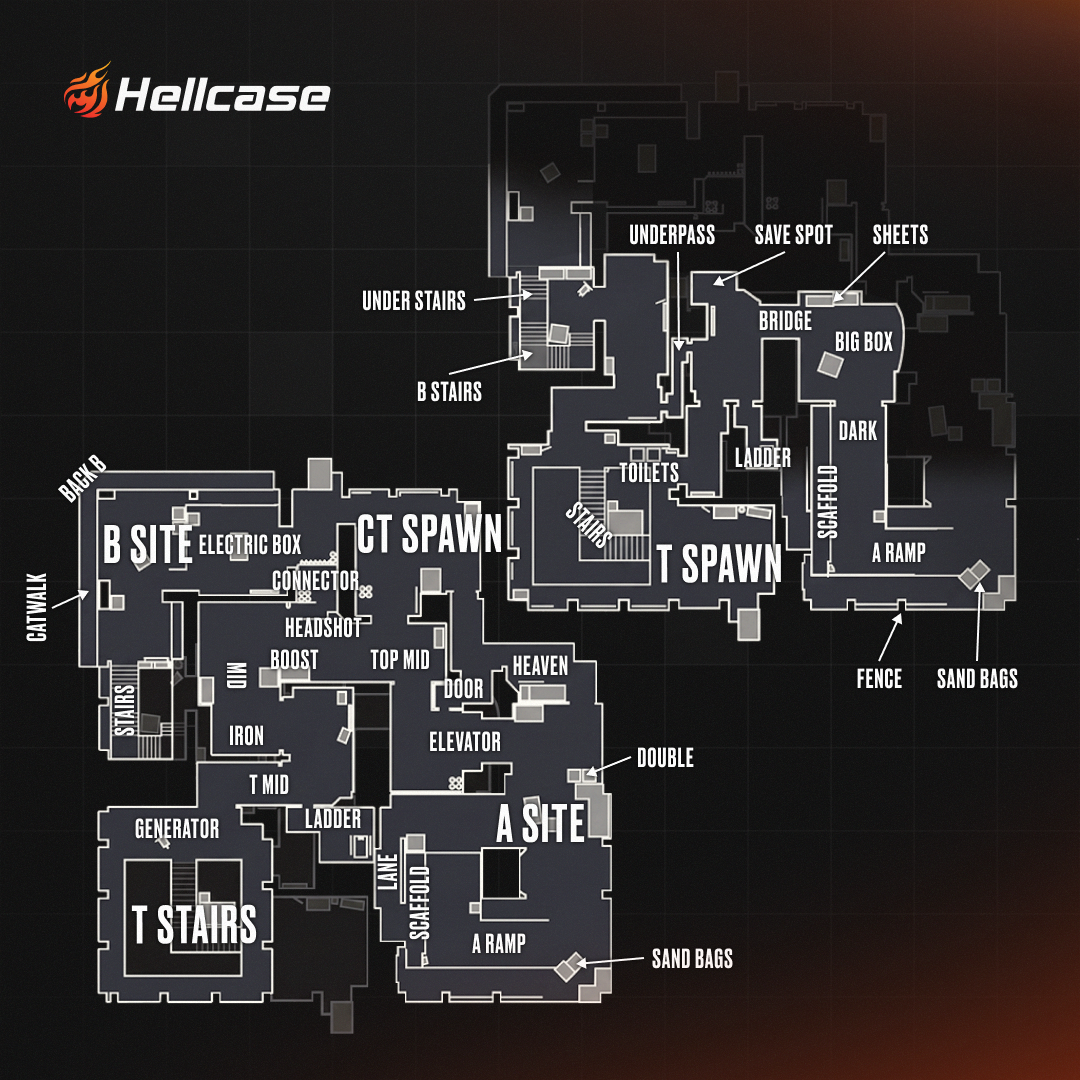
Vertigo was introduced in the earliest versions of Counter-Strike and added to CS:GO in the October 1, 2012 update. It’s one of the few maps that isn’t based on some specific real areas, but has the look of an unfinished, two-story skyscraper under construction.
On this map, Terrorists need to bomb the building at one of two spots, while Counter-Terrorists must prevent it. The interesting detail is that both Sites are located on the upper floor along with CT Spawn, while T Spawn is on the lower floor.
As with other CS maps, the Mid control is key to success because it allows players to quickly rotate between sites. Still, the use of utilities (like Smoke on B Connector or Molotov on Mid) is essential for successful defending and attacking. In the end, Vertigo is known as CT-sided because it provides easy access to any location, even in post-plant scenarios.
Here, you can check all the Vertigo map callouts below:
How Vertigo Callouts Are Structured
Since Vertigo features a multi-layout, it could be helpful to understand the three main regions of the map. Here, we provide a table with all of them:
| Mid Callouts | A Site Callouts | B Site Callouts |
| Mid | A Ramp | B Ramp |
| T Mid | A Site | B Stairs |
| Top Mid (CT-Mid) | Sandbags | B Site |
| Connector | A Catwalk | B Catwalk |
| Boost | A Double (Tetris) | Back B |
| Headshot | Rafters | Double Box (First) |
| Iron | Elevator | Triple Box (Second) |
| Elevator | Highway | Electric Box |
| Scaffold (Construction) | Connector |
Now, it’s time to explore the main areas in detail.
T Spawn Area Callouts
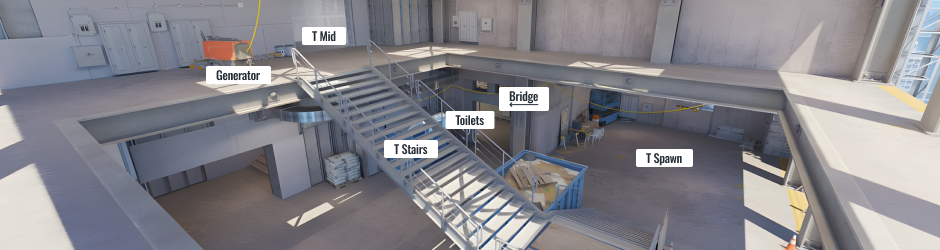
T Spawn area includes a short number of Vertigo map callouts. The first one is T Spawn, which is a landing place for attackers. Here you will see T Stairs leading to Generator and Mid, Toilets, and a route to Bridge and A Ramp.
Mid Callouts (Map Control Zone)
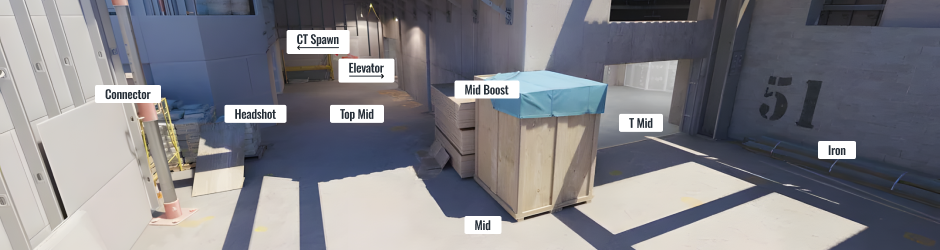
The Mid area is the map control zone. Here, players can expect to see locations like Mid, Top Mid (CT-Mid), T Mid, Headshot, Iron, Mid Boost, and Connector. From this area, players can rotate to both A Site and B Site. As a result, it makes the location especially important to control.
A Site Callouts (Upper Level)
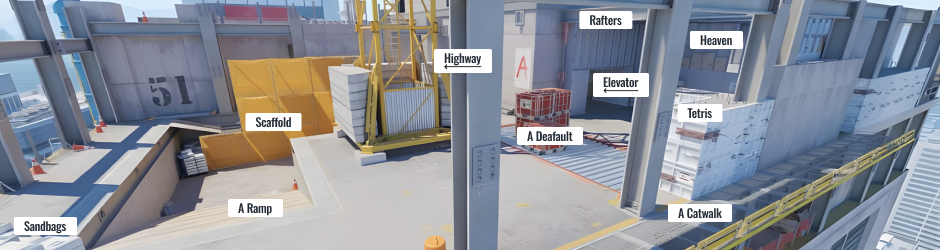
A Site callouts on Vertigo map include a number of positions, which is important to know. Among them are A Site (A Default), A Ramp, Sandbags, Scaffold, Double (Boost, Tetris), Heaven, Rafters, A Catwalk, Highway, and Elevator.
B Site Callouts (Lower Level)
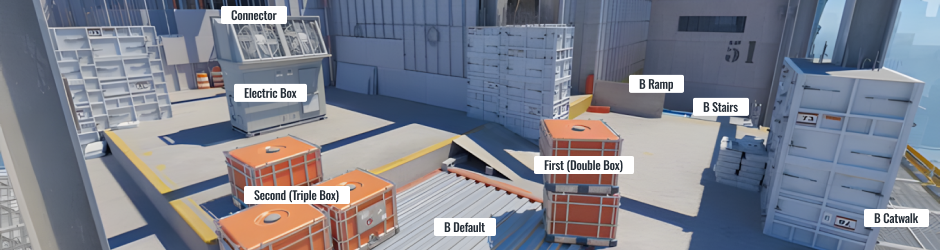
CS2 Vertigo callouts for B Site include B Default, B Catwalk, Back B, Electric Box, First (Double Box), Second (Triple Box), Connector, B Stairs, and B Ramp.
CT Side & Rotation Callouts
CT Side features an opportunity to move to both sites, along with Mid from CT Spawn. For B Site, players need to simply turn right while looking at Mid. For Mid, you just need to go straight. And for A Site, you need to take the left route to Heaven, Door, or Elevator.
The last callout could be useful if you defend A Site and see on the mini-map that the bomb-carrier enters B Site. In that case, you can move through Elevator to Top Mid and Connector, or to CT Spawn, and vice versa. If you attack Mid with no result, the nice rotation tactic could be to lurk through Ladder to B Ramp.
Overall, remember to communicate with your teammates to make the most of any rotations and ensure your strategy doesn’t fall.
Alternative & Regional Callouts
Of course, some Vertigo CS2 callouts have an alternative name. Their number isn’t high, but it’s better to know them to avoid any misunderstanding. For example, some players can call CT Connector as Platform. Also, A Heaven could be called as Tower. Double on A Site is also known as Boost or Tetris. Or, as another example, Dark near A Ramp is known as Dog, and Scaffold as Construction.
Most Important Vertigo Callouts to Learn First
For newcomers, it’s essential to understand the basic Vertigo callouts such as A Site, B Site, A Ramp, B Ramp, Mid, T Spawn, CT Spawn, CT Connector, and A Heaven. Additionally, it could be especially helpful to know Sandbags, Electric Box, B Double (First), B Triple (Second), A Double (Tetris), and Dark. By having at least these callouts, you can expect to get the right pre-aim or tell your opponents crucial information about the opponent’s position.
How to Use Callouts Effectively in CS2
As you can already see, Vertigo is a map where a clear understanding of position is especially important. That’s why it’s better to always call the level (Top or Bottom). No less crucial is to add the name of a specific site if you call Ramp (A Ramp and B Ramp on the opposite sides of the map). And yes, B Ramp and B Stairs are also different positions, or, rather, different angles to aim.
Also, it could be especially useful to call specifically Rafters, not just Heaven. The reason is that your teammates need to expect an opponent by using a different aim angle, which is key to defeating them. Additionally, give your team any detail, including the exact position (not just Mid, but Boost or Iron) and the possible number of opponents. In the end, timing (how soon the team will know the direction) will help you to win the next round.
Vertigo Callouts Strategy
Since we already mentioned the importance of layered communication, let’s check the most crucial locations to control. In fact, B Stairs, Mid, and Heaven are among the most important Vertigo map callouts. With only these three positions, CTs can control every site and instantly recognize the opponent’s strategy.
Overall, in mid-round, players need to call specific positions, such as Sandbags, Tetris, or Electric Box. And if you tell not just the position, but where opponents are falling back to, then the victory is closer than you think.
To Sum Up
CS2 Vertigo callouts could be among the most important, as understanding the opponents’ position directly affects the chance of success. No less crucial is to know where to expect the enemies’ rotation, especially if you have both Top and Bottom options. Still, with the right communication, teamwork, and practice, you can expect to master this map within a week or even days. Just keep our guide open on your phone so you remember the position and can share this crucial information with your teammates.
Looking for more information about CS2, its maps, strategy tips, or skins? Then be sure to visit Hellcase Blog. Here, you will find everything you need to level up your game and show an eye-catching loadout with the right design.
FAQ
Each callout is a location name. Players use them for different tasks. For example, it could help your team to coordinate rotations or simply identify opponents’ positions. Overall, callouts are key to quick, clear communication during a match.
This map is known for multi-leveling and vertical angles. Use of callouts helps players avoid misunderstandings about rotation and instantly understand the possible locations of opponents.
In general, there are 43 callouts. At the same time, the number of commonly used locations is smaller. In fact, it contains only 15-20 callouts for effective communication.
Of course, all the callouts are important. Still, it could help if you already know the standard locations. For example, this list includes A Ramp, A Site, A Heaven, B Site, B Stairs, T Lobby, Mid, and Boost.
Similar to Nuke, Vertigo features multi-layout. It directly affects the communication between players since it’s crucial to understand the specific floor an opponent is on, along with possible and fastest rotation.
There were updated map geometry and visibility changes. Still, the callouts remain the same.
The best strategy is to play on the map with friends who already know the callouts. While they use it, you can easily combine learning with practice at the same time. At the same time, it could help if you already know the basic areas. For example, among them are A Site, B Site, Mid, T Spawn, and CT Spawn.
It’s a raised platform that is located on Back A near the entrance to A Site. This location is a nice spot for the CT sniper to hold Ts from planting a bomb on A Site.

Radosław Davidović is Hellcase’s customer success manager. He enjoys blogging to share his knowledge and experience with customers.